
Hairline Design Planning Guide: What to Check
By Meditrust Team · Published
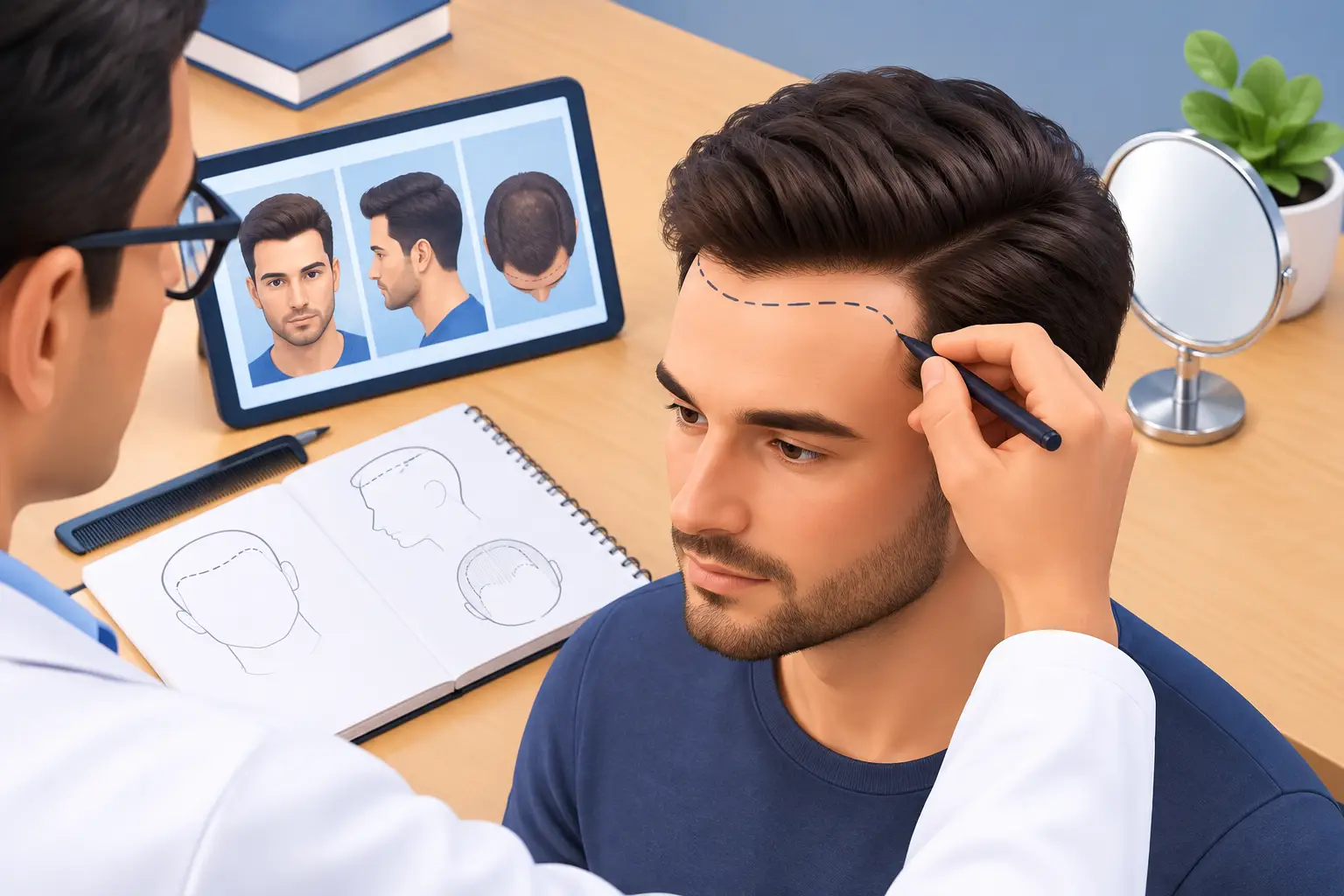
A hair transplant can add density, but the hairline is what people tend to notice first. If it sits too low, looks too straight or uses more grafts than your donor area can comfortably provide, the result may become harder to manage over time. A careful hairline design planning guide should therefore begin well before flights, deposits or a proposed surgery date.
The right plan is not about copying a celebrity photograph or recreating the hairline you had at 18. It is about agreeing a shape that suits your face, current pattern of loss, family history and likely future needs. Thinking it through is the first step.
Hairline design is a long-term clinical decision
A natural-looking hairline usually has restraint built into it. It follows the proportions of the face without appearing drawn on, and it allows for the fact that hair loss can progress. This matters particularly for younger patients or those with active thinning behind the front line.
A surgeon should assess the whole scalp, not simply the empty area at the front. A dense, low hairline may look appealing in a pre-treatment mock-up, but it can consume grafts that may later be needed for the mid-scalp or crown. There is no single correct height or shape. The sensible choice depends on your individual donor supply and the stability of your hair loss.
It is also worth being candid about expectations. A transplant redistributes hairs from a finite donor area, usually at the back and sides of the scalp. It does not stop ongoing loss in non-transplanted hair. For some people, medical treatment may be discussed alongside surgery; for others, it may not be suitable or desired. That is a conversation to have with a qualified clinician, based on your medical history.
Start with your pattern of loss and donor supply
Before discussing design details, ask how the clinic has assessed your hair loss. Good planning normally involves clear photographs, a medical questionnaire and, where appropriate, a consultation with the operating clinician. An in-person assessment can provide more certainty than photos alone, particularly when donor density or scalp characteristics are unclear.
The donor area deserves as much attention as the proposed hairline. Taking too many grafts can leave visible thinning or an over-harvested appearance at the back of the head. A responsible surgeon should explain the estimated graft range, why that range is appropriate and what they are seeking to preserve for the future.
Ask whether the quoted graft number is an estimate or a guaranteed extraction target. The answer matters. Graft requirements can change after a direct examination, and a clinic should not make promises that ignore donor limitations. It should also be clear whether the price is based on grafts, a package or a stated treatment plan, and what is included in that price.
Questions to raise before agreeing the design
Bring reference images if they help explain what you like, but treat them as a starting point rather than a blueprint. During planning, ask:
- How has my donor area been assessed, and how many grafts can reasonably be used now?
- Is my current hair loss stable enough for this design, or is a more conservative approach sensible?
- How will the design account for possible thinning behind the transplanted area?
- Who will create the hairline and make the final clinical decision on the day?
- Will I be shown the proposed placement before the procedure begins?
A clear answer should not feel rushed or overly sales-led. If every concern is met with a promise of maximum density, pause and ask for a fuller explanation.
What makes a hairline look natural?
Natural hairlines are rarely perfectly symmetrical. They tend to have small irregularities, softer transitions at the front and an age-appropriate position. Hair direction and angle are just as significant as the drawn outline. Fine, single-hair grafts are often used at the leading edge, while grafts containing more than one hair may contribute behind it, depending on the treatment plan.
The temples matter too. Restoring them can change the perceived frame of the face, but they are technically demanding and may not be appropriate for every patient. A surgeon should explain whether temple work is advised, optional or best avoided in your case.
Facial proportions can inform the discussion, but they should not become a rigid formula. Hair texture, curl, skin-to-hair contrast, existing hair calibre and how you usually wear your hair can all affect the visual result. Someone who wears their hair very short may need a different approach from someone who styles it forward with longer coverage.
Your hairline design planning guide for clinic checks
The clinic matters as much as the surgeon. When treatment is overseas, it is especially important to know exactly who is responsible for each stage and where it will take place. A polished social-media page does not answer those questions.
Check that the clinic can provide a named surgeon, a clear address and an explanation of the team’s roles. In FUE treatment, ask who performs extraction, channel opening or recipient-site creation, and implantation. Titles vary between clinics, so plain answers are more useful than marketing language.
You should also receive a written treatment outline before travelling. It should set out the planned procedure, estimated graft range, number of treatment days, what is included, medication and aftercare arrangements, and any costs that could arise outside the stated quote. If accommodation or transfers are offered, confirm the dates, locations and what happens if your clinical schedule changes.
For UK patients considering Turkey, independent clinic scrutiny can remove some of the uncertainty. Meditrust coordinates access to accreditation-checked partner clinics following licensing and hygiene reviews, on-the-ground visits and ongoing patient feedback. The purpose is not to push every patient towards surgery, but to help them get matched, not sold to.
Plan the trip around recovery, not just the procedure
Hair transplantation is commonly arranged over a short trip, but your schedule should leave room for consultation, treatment and the first check before you fly home. Avoid committing to late-night travel or a packed sightseeing itinerary immediately afterwards. You may feel tired, have dressings or need instructions repeated before departure.
Ask in advance when you can wash your hair, wear a hat, exercise, return to work and resume other normal activities. These instructions can differ according to the procedure and your clinician’s advice. You should also understand what swelling, redness, scabbing and shedding may be expected, as well as the signs that mean you should contact the clinic promptly.
It is sensible to arrange practical support at home if you can. You may not need it, but having someone available for the first day or two can make following aftercare simpler. Keep the clinic’s contact details, written instructions, invoices and treatment notes together. If you need advice after returning to the UK, accurate records help avoid fragmented communication.
Be wary of fixed promises about density and outcomes
No ethical provider can guarantee an identical result for every patient. Growth timing, density, donor characteristics and the behaviour of existing hair vary. Many patients experience initial shedding of transplanted hairs before regrowth becomes visible, and meaningful change takes months rather than weeks.
Before proceeding, ask to see relevant, consistently photographed cases with a similar pattern of loss and hair characteristics to yours. Ask when the after photographs were taken, whether patients had more than one procedure and whether medication was used. A single impressive result without context is not enough to judge likely outcomes.
A good plan also includes what happens if you have concerns once you are home. Establish who your named contact is, how you send photos for review, expected response times and whether the clinic provides a follow-up schedule. Aftercare should not end at the airport.
Your best hairline is unlikely to be the lowest possible one. It is the one you can live with comfortably as you get older, supported by a treatment plan that protects your donor area and gives you a clear route back to help if you need it.
Already have a quote or a photo of your smile?
Send it to us on WhatsApp for an honest, confidential second opinion from our Dorset team. Free, and no obligation.
Work out your own cost with our Turkey teeth cost calculator
Prefer the full form? Start your enquiry