
FUE versus FUT Procedures: Which Fits You?
By Meditrust Team · Published
A hair transplant consultation should not begin with a promise of a certain number of grafts. It should begin with your donor hair, the pattern and likely progression of your loss, and the result you can realistically maintain. When comparing FUE versus FUT procedures, the central question is not which method is universally better. It is which approach protects your donor area while supporting a sensible long-term plan.
FUE versus FUT procedures: the practical difference
Both FUE and FUT are methods of taking healthy hair follicles from the donor area, usually at the back and sides of the scalp, and placing them in thinning or bald areas. The implanted hair can then grow in its new position. The difference lies in how those grafts are removed.
What happens with FUE?
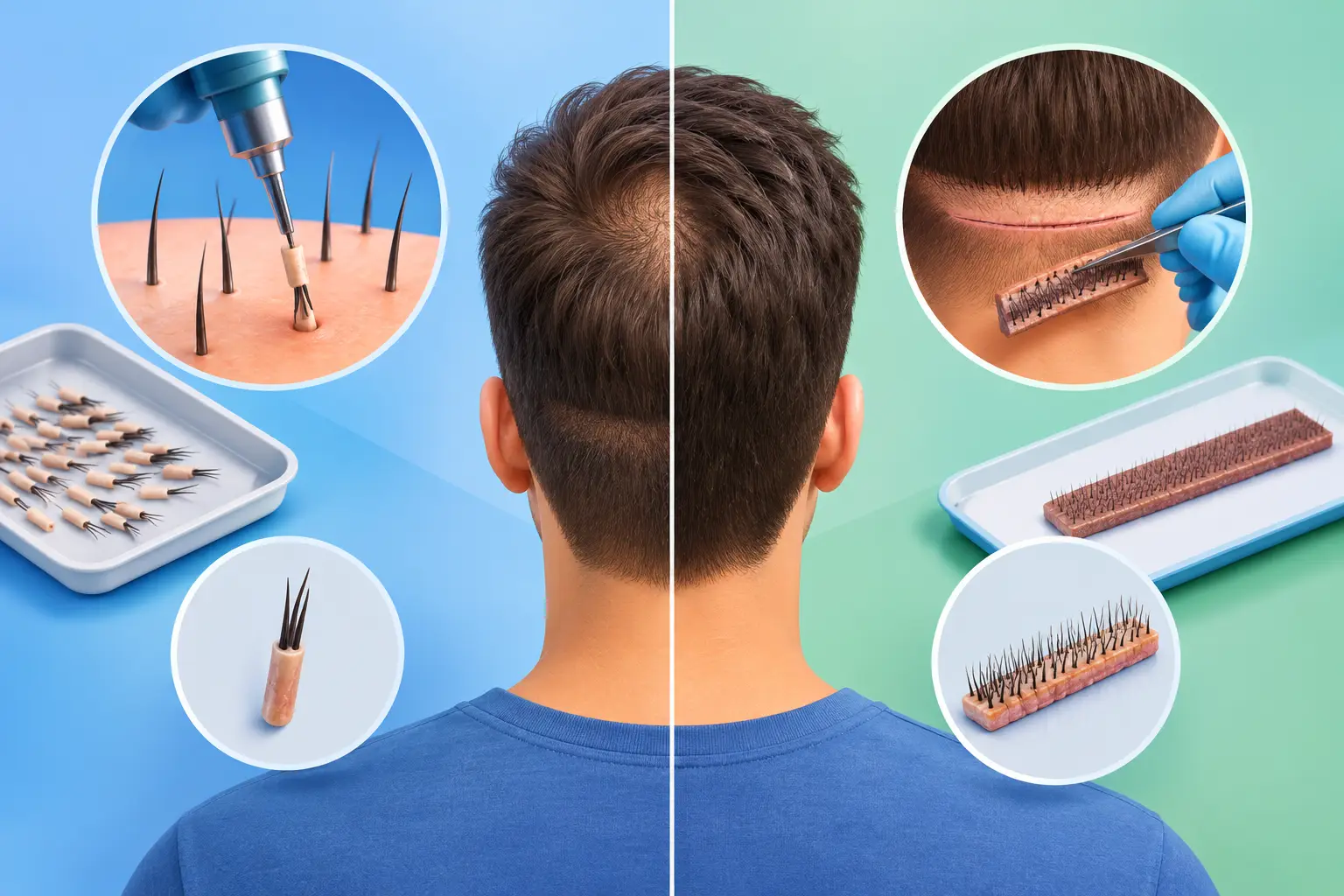
FUE stands for Follicular Unit Extraction. The clinician removes individual follicular units, usually containing one to four hairs, using a small punch tool. The grafts are then prepared and implanted according to the agreed hairline and coverage plan.
Because follicles are taken individually across a wider donor area, FUE leaves many very small circular scars rather than one line. These marks often become difficult to see once healed, particularly with a little hair growth, but FUE is not scar-free. Donor overharvesting, poor extraction technique or unrealistic graft numbers can still leave the donor area looking thin or uneven.
FUE is commonly chosen by people who prefer to keep their hair shorter, who do not want a linear scar, or whose work and lifestyle make a quicker return to light daily activity appealing. The donor area is usually shaved for the procedure, although the extent of shaving varies by clinic and treatment plan.
What happens with FUT?
FUT stands for Follicular Unit Transplantation. It is also known as strip surgery. A narrow strip of scalp is removed from the donor area, and the clinical team separates it into individual grafts under magnification. The donor area is then closed with stitches or staples, depending on the technique used.
FUT leaves a linear scar at the back of the scalp. In the right hands, and with appropriate closure, this can be fine and sit beneath longer hair. It may be less suitable, however, for someone who plans to wear a very short fade or regularly shaves their head.
One reason FUT remains part of the discussion is graft yield. It can allow a surgeon to obtain a substantial number of grafts from a defined donor area without spreading extractions across it. For patients with significant hair loss and a suitable scalp, this may be useful. It does not mean FUT is automatically the better choice, as the scar, healing process and future donor strategy must all be considered.
The trade-offs that matter most
The best procedure depends on details that are easy to overlook when comparing before-and-after photographs. Hair characteristics, scalp laxity, family history of hair loss and future treatment goals can matter as much as the method itself.
Scarring and hairstyle
If avoiding a linear scar is your priority, FUE may be preferable. Small FUE extraction scars can still be visible in closely cropped hair, especially if too many grafts have been removed from one area. FUT creates a single line, which can be concealed effectively by longer hair but is harder to hide with a short cut.
Neither approach should be sold as invisible. A responsible consultation discusses where scarring will sit, how you wear your hair now and how you may want to wear it later. If you are unsure, ask to see healed donor results on people with hair similar in texture, colour and density to yours.
Donor supply and future loss
Your donor hair is limited. It is not simply a source of grafts for one procedure. A careful plan considers whether you may need treatment again if your natural hair continues to thin.
FUE distributes extraction points throughout the safe donor zone. This can preserve flexibility, but taking too many grafts can reduce visible density. FUT may preserve some areas for later FUE, although a previous strip scar and scalp tension must be factored in. A good surgeon will not treat the donor area as an unlimited resource simply to create an impressive-looking graft figure.
Recovery and comfort
FUE generally involves small wounds that form scabs and heal over the following days and weeks. Tenderness, redness and temporary numbness can occur. FUT involves a surgical incision and closure, so the donor area may feel tighter and require more careful management while it heals.
Neither is a no-recovery procedure. You will need clear instructions for washing, sleeping, exercise, headwear, work and travel. Swelling around the forehead can happen after either method, and transplanted hairs commonly shed before new growth begins. Early shedding is often part of the normal cycle, not proof that the transplant has failed.
Cost and value
FUE is frequently priced per graft or by treatment package, while FUT may be priced differently because of the surgical process involved. Comparing a headline price alone rarely tells you enough. The proposed graft number, who performs each stage, medications, accommodation, transfers, follow-up and any extras should be clear in writing.
Lower cost abroad can be a genuine reason to consider treatment in Turkey. It should not replace proper checks on the clinic, the surgeon's involvement or the standard of aftercare. The clinic matters as much as the procedure.
Who may be suited to each method?
FUE may suit someone with stable hair loss, adequate donor density and a preference for avoiding a linear scar. It can also be useful where a smaller session is planned, or where grafts are needed for areas such as the hairline, crown, eyebrows or beard. That said, suitability is clinical, not cosmetic. A short haircut preference alone should not decide the plan.
FUT may be worth discussing if a larger number of grafts is required, scalp laxity is favourable and the patient is comfortable keeping enough hair length to cover a linear scar. It can be especially relevant where preserving donor resources for the future is a priority.
Some people may be advised against either procedure for now. Very early or rapidly progressing hair loss, poor donor density, certain scalp conditions and unrealistic expectations are all reasons to pause. A trustworthy provider should be willing to say that treatment is not appropriate, or that medical management and observation should come first.
Choose the plan before the procedure
The procedure name can become a distraction. The more useful conversation is about what can be achieved without compromising the future.
A considered treatment plan should cover the proposed hairline, how much native hair is likely to remain, the number of grafts that can be taken safely, and what happens if loss progresses. A low, dense hairline may look appealing in a photograph, but it can be difficult to maintain if the surrounding hair continues to recede.
It is also worth asking who will carry out each part of the treatment. In some clinics, the surgeon designs the hairline and oversees the operation while technicians undertake extraction or implantation. Roles and supervision should be explained clearly before you book. You should know who is accountable, not just who you spoke to on the phone.
For UK patients travelling to Turkey, the practical side deserves the same attention. Allow enough time for your pre-operative assessment, the procedure and an in-person check before flying home. Confirm what support is available if you have concerns once you are back in the UK, and keep written aftercare instructions rather than relying on a brief verbal explanation.
Meditrust coordinates access to clinics that have been checked in person and can help patients compare the clinical plan, itemised costs and travel arrangements with one named contact throughout. That coordination does not replace a surgeon's assessment, but it can make it easier to ask the right questions before committing.
Questions to ask before you decide
Before choosing between FUE and FUT, ask for direct answers to the following:
- How many grafts are being recommended, and why is that number safe for my donor area?
- What scarring should I expect, based on my planned hairstyle and hair characteristics?
- Who will perform the extraction, implantation and surgical elements of the procedure?
- What is included in the written quotation, including medication, transfers, accommodation and follow-up?
- What aftercare is available once I return home, and who should I contact if something worries me?
A clinic that answers these questions carefully is giving you more than a sales pitch. It is showing whether it has planned for the person behind the procedure.
The right choice is not the one with the most persuasive label or the lowest advertised price. It is the one that respects your donor hair, your health and the life you will be living with the result years from now.
Already have a quote or a photo of your smile?
Send it to us on WhatsApp for an honest, confidential second opinion from our Dorset team. Free, and no obligation.
Work out your own cost with our Turkey teeth cost calculator
Prefer the full form? Start your enquiry