
All on Four Versus Implants Compared Clearly
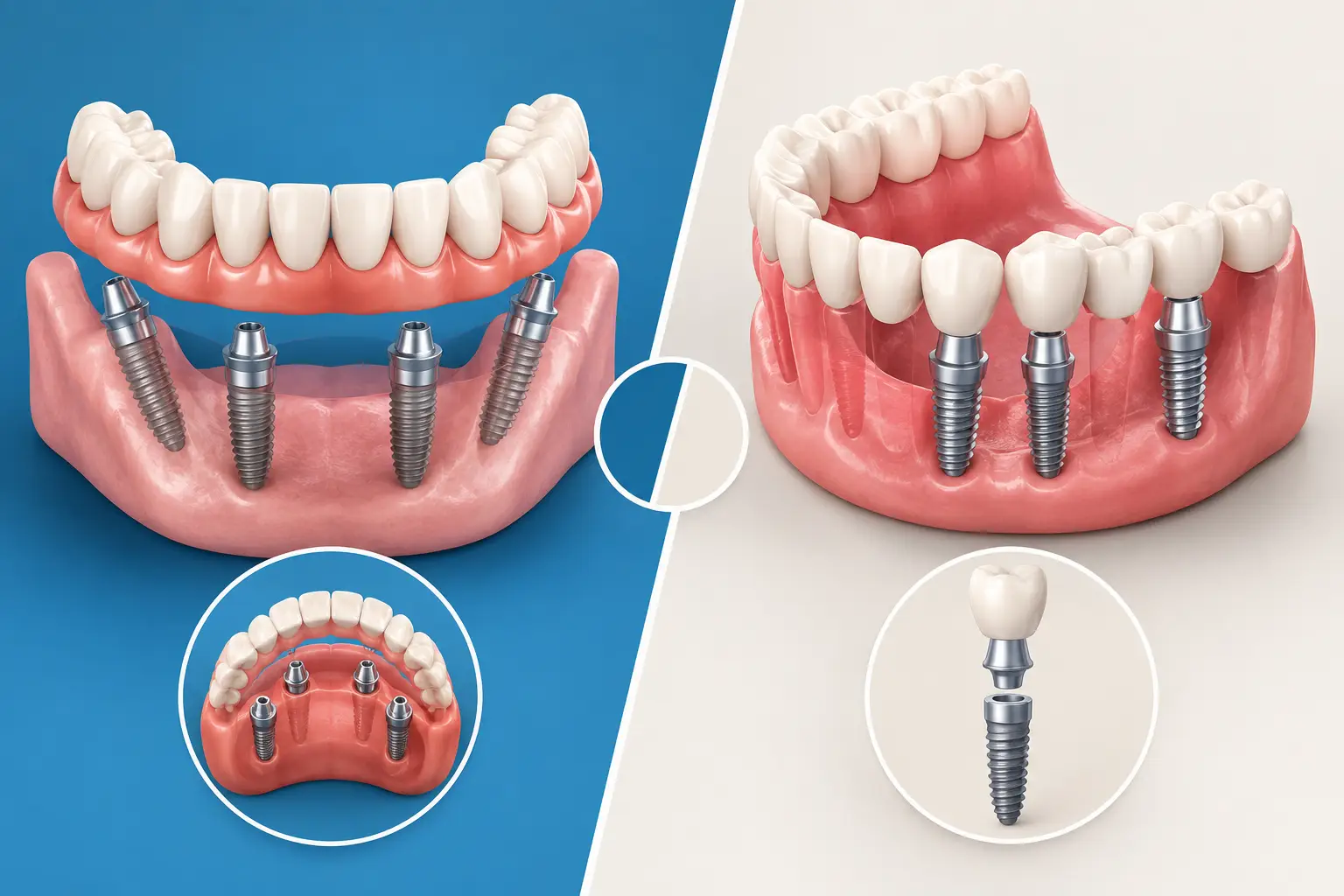
A choice between all on four versus implants can sound straightforward, but the two treatments are not quite opposites. All-on-4 is itself an implant treatment. The real decision is whether you need a full-arch solution supported by four implants, or individual implants designed to replace one tooth, several teeth, or a smaller section of the mouth.
That distinction matters. It affects the clinical planning, the number of appointments, whether teeth need to be removed, the type of bridge fitted, healing time and the long-term maintenance you should expect. A good clinic should not steer you towards the quickest-looking option before it has assessed your scans, gum health, bite and remaining teeth.
All on Four versus implants: the key difference
An individual dental implant replaces the root of a missing tooth. A titanium implant is placed into the jawbone and, once it has integrated, it can support a crown. Where several teeth are missing, multiple implants may support a bridge. This approach aims to preserve healthy natural teeth wherever possible and replace only what is needed.
All-on-4 is intended for someone who needs a whole upper or lower arch restored. Four implants are placed at planned positions in the jaw, usually with the rear implants angled to make best use of available bone. They support a fixed full-arch bridge, rather than a separate implant for every missing tooth.
In suitable cases, the clinic may fit a temporary fixed bridge shortly after implant placement. The final bridge is normally fitted after a healing period, when the implants and surrounding tissues have stabilised. Immediate teeth do not mean the treatment is finished on the day of surgery.
When a full-arch solution may be appropriate
All-on-4 may be considered if most or all teeth in an arch are missing, failing, loose or heavily restored. It can also suit patients who are struggling with dentures and have enough bone in the areas selected for implant placement.
One practical advantage is that it can avoid placing a large number of implants. In some cases, the angled placement of the back implants can also reduce the need for bone grafting. That may shorten the overall programme, although it is never something that should be promised before proper imaging and assessment.
It is not automatically the best option simply because several teeth have problems. If healthy, stable teeth can be retained, removing them to create a full arch may be unnecessarily aggressive. A dentist should explain why each tooth is being kept or removed, using your X-rays or CBCT scan as part of that discussion.
Full-arch implant work also demands good habits after treatment. The bridge is fixed, but it still needs careful cleaning beneath it, usually with interdental brushes, water flossing where advised, and regular hygienist reviews. It is not a maintenance-free set of teeth.
When individual implants can make more sense
If you have one missing tooth, an individual implant and crown is often the more conservative option. The same can apply when a few teeth are missing but the neighbouring teeth and gums are healthy.
Individual implants can offer a more natural approach to rebuilding the mouth gradually. They may also make future maintenance simpler because each crown or bridge section is smaller. However, treatment can become more complex where there is significant bone loss, gum disease, limited space or a heavy bite.
Replacing many missing teeth one by one is not always the right answer either. It can require more surgery, more implants, more healing sites and a higher overall cost. The number of implants should follow a clinical plan, not an assumption that more is always better.
The assessment should decide, not the advert
A responsible recommendation starts with the condition of your whole mouth. A clinic should review the following before confirming whether All-on-4 or individual implants are suitable:
- the quantity and quality of jawbone, assessed through suitable imaging
- active gum disease, infection and the health of any remaining teeth
- your bite, jaw function and signs of grinding or clenching
- medical history, medications, smoking or vaping, and healing risks
- your expectations around appearance, fixed teeth, treatment time and maintenance
For full-arch treatment, the planning should also consider the smile line, facial support and the space needed for the final bridge. A bridge that looks bright in photographs but is too bulky, difficult to clean or poorly balanced in the bite is not a good result.
If you are considering treatment abroad, ask who reviews your records before you travel and what happens if the in-person examination changes the proposed plan. A preliminary quote can be useful, but it should remain provisional until the clinical assessment is complete.
Treatment time and recovery
Individual implants are often staged. After an extraction, some patients need time for the socket to heal or require bone grafting before the implant is placed. Others may be suitable for immediate implant placement. Once placed, implants commonly need a period of healing before the final crown or bridge is fitted.
All-on-4 can sometimes offer a faster route to fixed temporary teeth, particularly where failing teeth are removed and implants are placed during the same visit. But the first few months still require care. You may need a soft-food diet, prescribed cleaning routine and follow-up checks while healing takes place.
Recovery varies between people. Swelling, bruising and soreness are common after surgery, especially where extractions have been carried out. Pain that worsens, persistent bleeding, fever, a loose temporary bridge or swelling that affects breathing or swallowing requires prompt clinical advice. Do not wait until you are due to travel home if something feels wrong.
Comparing costs without comparing only the headline figure
All-on-4 is often presented as a single price per arch. Individual implants are usually priced per implant, abutment and crown, with additional charges possible for extractions, grafting, temporary teeth or sedation. Neither pricing structure is automatically better value.
What matters is whether the quotation states exactly what is included. For a full-arch case, check the implant system, temporary bridge, final bridge material, extractions, scans, medication, laboratory work and planned review appointments. For individual implants, confirm the number of implants, crowns or bridge units, any grafting and whether a temporary restoration is included.
A lower figure can become misleading when essential clinical steps are excluded. Equally, an expensive quote is not proof of better planning. Ask for an itemised treatment plan and ensure you understand what may change if the scan reveals a different situation.
Turkey can offer lower private treatment costs than the UK, but the clinic matters as much as the surgeon. Its hygiene standards, implant systems, laboratory work, communication and approach to follow-up all affect the experience and outcome.
Questions worth asking before you commit
You should feel comfortable asking whether the proposed treatment is All-on-4, All-on-6 or individual implants, and why that option suits your mouth. Ask what bridge material is planned for the temporary and final stages, how long you will need to stay, and whether a second trip is needed for the definitive bridge.
It is also sensible to ask how complications are handled once you are back in the UK. Implant treatment involves a biological healing process, so no clinic can guarantee that every implant will integrate. What they can do is explain their protocol, documentation, warranty terms and the practical support available if you need advice after travelling.
For patients who want a UK point of contact while arranging treatment in Turkey, Meditrust can help coordinate records, clinic matching, travel timing and ongoing communication. That does not replace the dentist’s clinical responsibility, but it can prevent the fragmented handovers that make a major treatment feel harder than it needs to be.
The right choice is rarely the one with the boldest before-and-after photograph. It is the treatment that protects what can be saved, replaces what cannot, and gives you a realistic plan for cleaning, review and support long after you have travelled home.
Talk it through with us
Initial advice is free. A named coordinator will answer your questions.
Start your enquiry